Loading…
Audio guide
On the way to the castle
Open this page on your phone at the start: it tells you about every chapel and stop, knows where you are thanks to GPS and works even where there is no signal.
Tip: add the site to your Home screen (Share menu → “Add to Home Screen”) to open it like an app on the mountain.
- •
Stop 1/16
The Basilica of St. Jerome
Welcome to Somasca. This basilica holds the remains of St. Jerome Emiliani, the Venetian nobleman who in the sixteenth century chose this village as a home for orphans. The Way of the Chapels starts here: eleven small chapels tell his life, scene by scene, all the way to the castle. Take your time: in forty-five minutes you will be at the top.
- 1
Stop 2/16
Chapel 1 · The liberation
It is 1511. Jerome, a young officer of the Republic of Venice, defends the fortress of Castelnuovo di Quero, is captured and chained. Tradition tells that after he prayed to Our Lady his chains fell away and the Virgin herself set him free. This is the beginning of his conversion.
- 2
Stop 3/16
Chapel 2 · Through the enemy camp
Once free, Jerome has to cross enemy lines to reach safety. According to the story, protected by Mary, he walks among the soldiers without being seen. The scene invites trust even when the road seems blocked.
- 3
Stop 4/16
Chapel 3 · The chains in Treviso
In gratitude, Jerome takes the chains of his captivity to the altar of the Madonna Grande in Treviso as a votive offering. From soldier to pilgrim: here his military life ends and a life devoted to others begins.
- 4
Stop 5/16
Chapel 4 · The poor and the orphans
Back in Venice, in years of famine and epidemics, Jerome feeds the poor and takes in the children left alone on the streets. He sells his goods, houses them and teaches them a trade: this is how the work begins that will make him the father of orphans.
- 6
Stop 6/16
Chapel 6 · The sick
This chapel recalls the healings attributed to Jerome. His companions’ accounts speak of the sick cared for with his own hands and of prayers answered. The chapels are not always in order along the path: number 5 is a little further on.
- 5
Stop 7/16
Chapel 5 · The plague victims of the valley
When plague strikes the Valle San Martino, Jerome does not flee: he nurses the sick and buries the dead whom no one dares to touch. It is the charity that, a few years later, will cost him his life.
- •
Stop 8/16
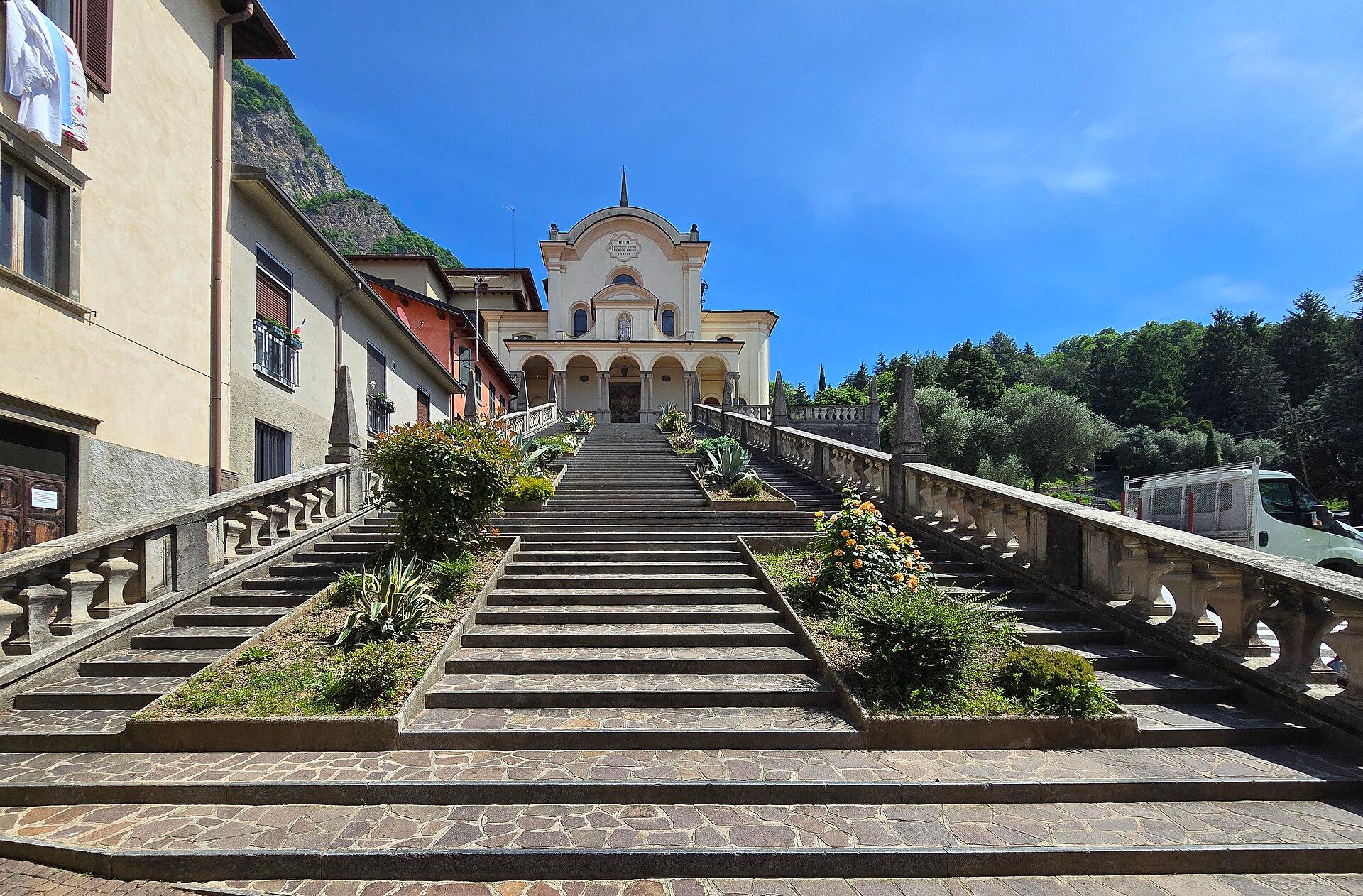
The Holy Stairs
Here the Holy Stairs begin, a steep flight that, as is the custom at sanctuaries, may only be climbed, never descended, in a spirit of prayer. If you prefer an easier pace, keep to the lane: the two routes meet again higher up, at the Valletta.
- 7
Stop 9/16
Chapel 7 · The wolves
One of the scenes children love most: with the sign of the cross, Jerome drives away the wolves threatening his orphans. Beyond the legend, it tells of a man who stands between the smallest and danger.
- 8
Stop 10/16
Chapel 8 · With the farmers
Jerome works in the fields alongside the valley’s farmers and, while hoeing and harvesting, teaches them the catechism. In Somasca faith passes through shared work, not lofty speeches.
- 9
Stop 11/16
Chapel 9 · The washing of the feet
Feeling the end approach, Jerome washes his orphans’ feet, as Jesus did with the apostles. It is his testament: serving the least until his very last day.
- 10
Stop 12/16
Chapel 10 · Death in Somasca
On 8 February 1537, infected while nursing plague victims, Jerome dies in a little house in Somasca. He would be canonised in 1767 and, in 1928, proclaimed universal patron of orphans and abandoned youth.
- •
Stop 13/16
The Valletta and the Miracle Spring
You are at the Valletta hermitage, the secluded spot beneath the rock where Jerome withdrew to pray. Here is the Miracle Spring: tradition says that in 1534 and 1535 water sprang from the rock for his boys. You can refill your bottle. Note: this area has opening hours, and outside them you go down via the Chiuso side.
- •
Stop 14/16
The last stretch
Behind the sanctuary the path climbs among trees and rock, with steps cut into the limestone. This is the Tremasasso spur, the last outcrop of Mount Magnodeno. A few more minutes and the woods will open onto the valley.
- •
Stop 15/16
The Castle of the Unnamed
You made it: you are at about 420 metres, within the walls of the Rocca di Vercurago. For centuries this castle watched over the border between Milan and Venice; then it was damaged by wars and finally, with Manzoni, it became the castle of the Unnamed. Nearby are the chapel of Sant’Ambrogio, the tower with the eleventh chapel and the great cross. Mind the edges: the walls drop sheer to the rock.
- •
Stop 16/16
The terrace and the view
Below you lie Lake Garlate and the course of the Adda; just to the north, beyond Lecco, begins “that branch of Lake Como” with which the novel opens. All around are the town of Lecco, the jagged outline of the Resegone and the lone bulk of Monte Barro. At sunset the lake turns red: if you stay, remember that much of the path down is unlit.
The map
Tap ◎ to see your position on the trail.